Explore
Everything AION read, in seven sections. Pick one, a topic or a time window.
MiMo-V2.6: Scaling Reinforcement Learning Towards Self-Improvement
Reinforcement learning (RL) is the central training paradigm for advancing large foundation models towards self-improvement.
 Video
VideoStop Renting Intelligence: The Train-to-Deploy Loop for Specialized AI — Fireworks AI
Jetashree Ravi, who leads part of the applied machine learning team at Fireworks AI, explains how teams move from closed models to open ones without losing quality.

Why AlphaFold Didn't Solve Protein Folding — Pushmeet Kohli, Google DeepMind & Sal Candido, Biohub
From the Bitter Lesson of AI scaling to the unsolved mysteries of protein folding, Google DeepMind’s Pushmeet Kohli and Biohub’s Sal Candido are rethinking what it takes to build AI that truly understands biology.
Converting dense models into Mixture-of-Experts
For the past few weeks I've been trying out converting existing dense models to sparse Mixture-of-Experts models, with no pretraining from scratch.
MetaOPD: Meta-Learned Token Weighting for On-Policy Distillation
In this paper, we propose MetaOPD, a bilevel optimization framework that jointly learns the student model and a lightweight token-weighting network.
Agent Lightning v1.0: A 3,500-Line Lightweight Agentic RL Framework for Training Agents with Real Harnesses
Harnessed Agentic RL: Microsoft Research Asia introduces a training paradigm in which the same agent harness used in deployment participates directly in reinforcement learning, removing the need to reimplement the agent inside the training framework.
Toward provably private learning from federated data
In 2017, Google introduced Federated Learning (FL) a machine learning technique that trains models across decentralized, private data.

I trained a 414k-parameter transformer to fly a boids flock, then tested whether the rules a probe can read are the ones it uses [P]
I wrote a small boid simulator (12 birds), recorded it flying, and trained a transformer to predict each bird's next move without it knowing about any boid rules.
Scale Bitwise-Deterministic Pretraining with NVIDIA Megatron Core
Bitwise determinism makes large-scale pretraining easier to debug, validate, and resume reproducibly.
Google Research RRSI Guide: Mastering Self-Improving AI Agents
In this tutorial, we implement RRSI (Regularized Recursive Self-Improvement), a method that lets an LLM agent rewrite its own harness, prompts, tools, memory, control flow, and sub-agents around a frozen model, without the harness overfitting to the tasks it evolves on.

Krea2 Turbo Distill 2 step LoRA - FINAL checkpoint released (chk51195)
Krea 2 Turbo — 2-Step Distillation LoRA (FINAL Version)
I expect rapid progress but not towards general superintelligence
I’ve often been surprised when I hear from top researchers in industry that they think AI will be better than them at their job in a few years, and I didn’t really know why I doubted it.
One Model Family, Two Gold-Level Results: Fine-Tuning Nemotron for IOI and IMO
Starting from Nemotron 3, our teams used supervised fine-tuning (SFT), reinforcement learning (RL), and feedback-driven inference to create systems that reached gold-medal level at both IMO 2026 and IOI 2026.
unslothai/unsloth v0.1.902-beta: Command Palette + Desktop UI/UX
This release brings faster navigation, shareable run settings, and clearer errors to Unsloth Desktop.
pytorch/pytorch v2.14.1: PyTorch 2.14.1 Release
This release is meant to fix the following regressions and silent correctness issues:
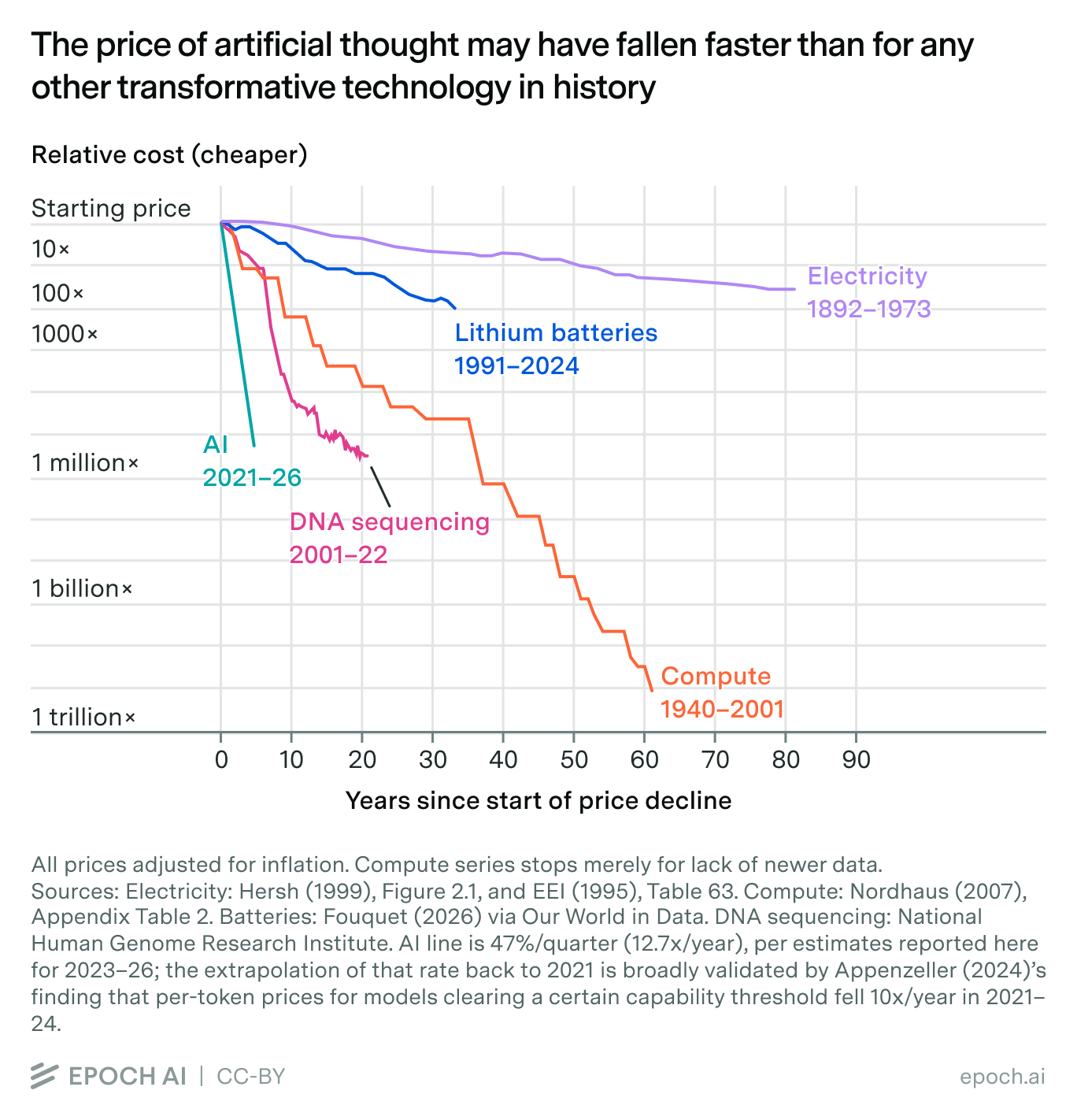
AI is getting cheaper faster than any other transformative technology
Because that’s how fast AI is getting cheaper.
huggingface/peft v0.21.1
This is a small PEFT release to enable Tensor Parallel (TP) to work properly with PEFT.
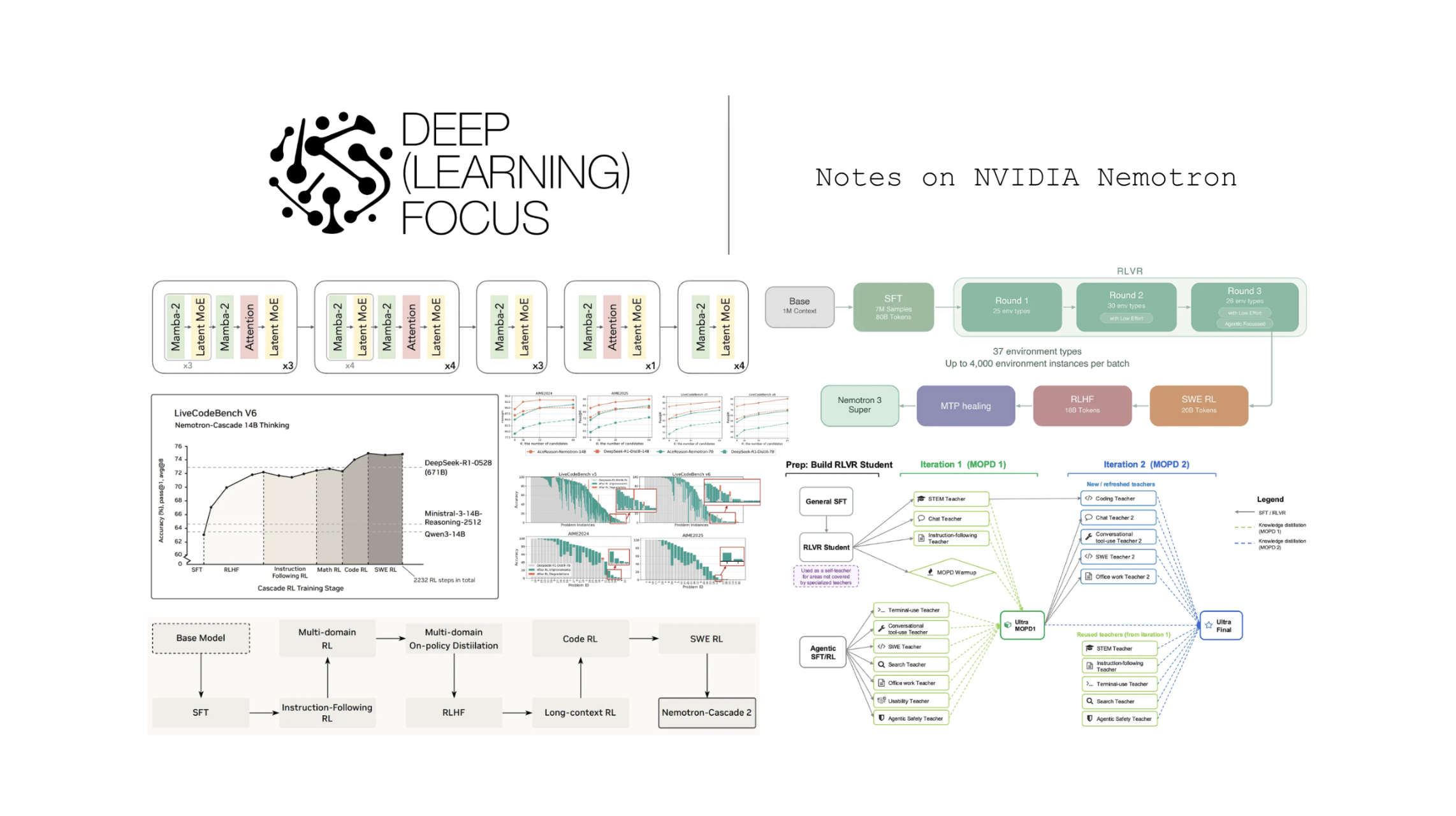
Notes on NVIDIA Nemotron
Today, many key details of frontier large language models (LLMs) remain proprietary, but open-weights model families—such as DeepSeek, Kimi, and MiMo—continue to provide a valuable window into the development process for modern LLMs. Among these resources, the NVIDIA Nemotron model series is especially useful due to its transparency.

SCLATE: A Substrate for Continual-Learning Agent Training and Evaluation
SCLATE: A Substrate for Continual-Learning Agent Training and Evaluation
One Block, Multiple Depths: Recurrent Vision Transformers with Depth-Programmed Experts
In this work, we show that a single Transformer block, applied recurrently, can match the accuracy of a full-depth vision encoder at comparable inference FLOPs without intermediate feature distillation. reViT restores depth-specific transformations by representing the FFN at each recurrent depth as a convex combination of a small shared expert bank.
Distilling Routed 3D Privilege for Spatial Reasoning in Vision-Language Models
Spatial reasoning remains a persistent weakness of vision-language models (VLMs), because RGB inputs do not directly provide geometric evidence.
A Closer Look at Agentic BBO: Benchmarking LLM Agents for Black-Box Optimization
We therefore introduce AgenticBBO-Bench, a cross-domain benchmark for agentic BBO spanning synthetic functions, hyperparameter optimization, database tuning, chip design, and molecular design under a unified finite-budget evaluation protocol.
RoboJEPA: Scaling Laws for Multi-Embodiment Robotic Latent World Models
Researchers introduced RoboJEPA, an 8B-parameter multi-embodiment latent world model that establishes compute scaling laws and enables zero-shot real-robot planning toward goal images.
 Video
VideoHill-Climbing Skills: Improve Agents Without Changing the Model — Shubhankar Srivastava, Browserbase
Shubhankar Srivastava uses that uneven progress to show how browser agents can learn a task without changing model weights.
 Video
VideoParameter Golf with AutoResearch — Vayum Arora, Zhengyao Jiang, Dixing Xu & Dhruv Srikanth, Weco AI
Zhengyao Jiang introduces autoresearch as repeated proposals and evaluations, and Dixing Xu explains the team's Aiden system and its contributions to OpenAI's Parameter Golf challenge.
Predicting Cable Dynamics with Physical Attention Bias
Learned simulators for deformable linear objects (DLOs) such as cables have to predict the motion of cables they were not trained on and stay stable over long rollouts.
Which Skill to Distill? SGUID: Selecting a Compact Skill Bank for Model-Skill Co-Evolution
Skills, reusable procedural guidance added at inference, can substantially improve LLM downstream performance (Li et al., 2026).
MotherTree: Meta-learning on synthetic data improves decision tree training
We introduce MotherTree, a tabular transformer that meta-learns decision tree induction: given a training set for a new task, it outputs a hard, axis-aligned decision tree, equivalent in form to classically trained trees, in a single forward pass.
EDiS: Edge Disjoint Subgraph Sparsification Framework for Graph Neural Networks
We introduce EDiS (Edge-Disjoint Subgraph sparsification framework), which separates one-time structural extraction from per-epoch graph composition.
MetaLearnNCA: Few-Shot Offline Meta-Learning via Interacting Neural Cellular Automata
In this work, we propose METALEARNNCA, a decentralized framework that achieves few-shot adapta- tion through the dynamical interaction of coupled Neural Cellular Automata (NCAs) without computing analytical gradients during inference.
asdex: Automatic Sparse Differentiation in JAX
Automatic sparse differentiation (ASD) exploits this structure in four steps: detection of the input-agnostic sparsity pattern, coloring of a graph to group columns or rows that can share an AD pass, compressed differentiation to compute a compressed derivative matrix with one AD pass per color, and finally decompression into the original sparsity pattern.
Cost-Aware Mixture-of-Experts Coordination for Model Markets
This paper proposes an MoE-based model market framework that lifts Mixture-of-Experts from a model-level learning architecture to a market-level coordination mechanism.
Smoothing the Top-k Exposure Boundary for Sparse Mixture-of-Experts
Sparse Mixture-of-Experts models scale parameter capacity efficiently while maintaining a fixed compute budget per token.
Expanding AI Storage Access with NVIDIA cuObject and the NVIDIA SCADA Server SDK
AI infrastructure engineers, storage developers, and cloud service providers need fast and secure access to high-capacity file and object storage to support AI...AI infrastructure engineers, storage developers, and cloud service providers need fast and secure access to high-capacity file and object storage to support AI workloads.
Executing Causal Structure Learning with Linear-Attention Transformers
We study a standard continuous method that repeatedly updates a candidate causal graph while enforcing acyclicity.
Leaner Transformers Can Easily Learn to Cluster
Recent work shows that transformers can exactly perform Lloyd's algorithm for $k$-means clustering with $n$ points in $d$ dimensions with an embedding size $d{\textsf{emb}} = d+k$ (thus, requiring attention projection matrices of size $(d+k)^2$).
Early Signatures of Memorization in Diffusion Models via Basin Geometry and Cyclic Denoising
We show that memorization is encoded in the geometry of the learned energy landscape before it appears in generated samples, a state we call latent memorization.
Minimax Gaussian Mechanisms for Continual Machine Unlearning
We develop Gaussian mechanisms for Newton updates under sequential deletion requests.
Expert Coupling in MoE Pretraining: Reducing All-to-All Overhead with Correlated Placement and Token Shuffling
Mixture-of-Experts (MoE) layers replace the feed-forward block of a Transformer with E expert networks, and each token is routed to k of these experts.
Shared Low-rank Basis Factorization for Data-free Mixture-of-Experts Compression
Mixture-of-Experts (MoE) large language models decouple capacity from compute through sparse routing, but their large parameter count creates storage and serving challenges.
Ambient Discrete Diffusion: Using the Wrong Data at the Right Time for Data Efficient Learning
We introduce RefineMix, a framework for training discrete diffusion models under severe data scarcity, a common constraint in scientific applications.
From Pareto to Preference: Personalized Test-Time Scaling via Amortized Agentic Policy Discovery
To reduce the overhead of repeated policy discovery for new user profiles, we propose PersonTTS, an amortized agentic policy-discovery framework that reuses prior search experience through requirement-matched controller initialization and source-distilled procedural guidance, while retaining target-profile evaluation for every candidate.
Forecast Accuracy Is Not Trading Profit: Evolving Small Recurrent Networks for Stock Return Prediction
We compare linear, fixed recurrent, transformer, and mixing based architectures against recurrent networks evolved by neuroevolutionary architecture search, evaluating each on forecast accuracy and on the net return of a daily long/short strategy.
Adversarially Trained Linear Transformers Are Optimal Robust In-Context Learners for Gaussian Mixtures
Specifically, we show that, for a family of Gaussian-mixture classification tasks, a sufficiently deep linear transformer adversarially trained across tasks can asymptotically attain the robust Bayes error on previously unseen tasks through in-context learning from clean demonstrations.
TAM: Task-Aware Memory Distillation for Efficient Spatiotemporal Prediction
Knowledge distillation enables efficient spatiotemporal prediction by transferring knowledge from an accurate teacher to a compact student.
Stability of Measure-to-Measure Transformers on Sub-Gaussian Data
We show that transformers map sub-Gaussian inputs to sub-Gaussian outputs; this ensures that taking arbitrary-length compositions of the softmax operator is well-defined.
Exact-Solution Volume and Length Generalization in Transformers
Research on transformer expressivity shows whether a transformer is capable of solving a given task, but gives little indication of whether the solution, if learned, is generalizable to longer input lengths.
Collaboratively Guided Adversarial Robust Distillation with Teacher-Favorable Examples
Adversarial distillation transfers robustness from high-capacity teachers to compact students.