Research
Papers and datasets worth knowing, ranked by significance and community attention.
 Paper
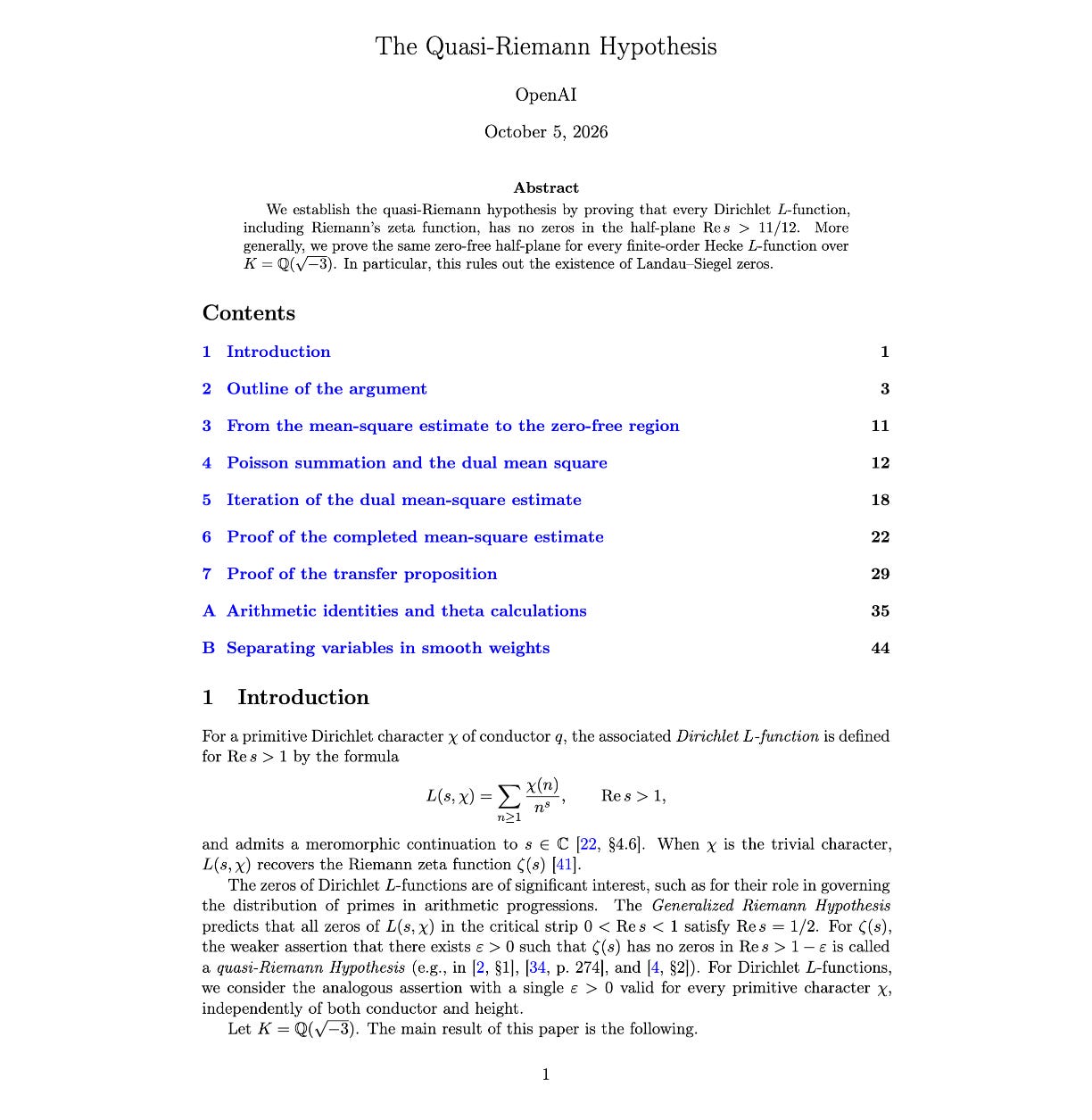
PaperSharing AI progress in mathematics
OpenAI publishes new results on open problems in mathematics from an internal frontier model and shares Lean proof formalizations and research details on GitHub.
 Paper
PaperBeyond Imitation: A Framework and Benchmark for LLM-Assisted Peer Review
Here, we introduce a verification-centric perspective on LLM-assisted peer review, emphasizing error detection as a critical and resource-intensive task.
 Paper
PaperRSI-Anything: Unlocking Recursive Self-Improvement with World Models
Recursive self-improvement (RSI) aims to transform interaction experience into persistent improvements, yet external feedback is costly and world-model predictions may become unreliable as policies evolve.
Memento 3: Model-Based Recursive Self-Improvement through Reflective Rulebooks
We introduce Memento 3, building on the Memento series to enable frozen LLM agents to continually learn explicit world models through external memory.
WorldGuide: Goal-Directed Video World Model for Procedural Task Execution
We formulate procedural video generation as closed-loop task execution in visual world space and introduce WorldGuide.
Distilling Routed 3D Privilege for Spatial Reasoning in Vision-Language Models
Spatial reasoning remains a persistent weakness of vision-language models (VLMs), because RGB inputs do not directly provide geometric evidence.
Scaling to Tens of Thousands of Test-Time Iterations with Loop-Native Attention Residuals
In this paper, we introduce InfiLoop, a loop-native residual connection that learns which past computations to retain and how much to accept from each new update.
Accurate but Not Humble: Evaluating Epistemic Humility in LLM Agents under Knowledge Conflict
We propose to evaluate agents on epistemic humility (EH): the agent's willingness to recognize, act on, and communicate uncertainty during task execution.
BrickBench: Evaluating Agentic Brick Design
We propose BrickBench, a benchmark for agentic text-conditioned LEGO-set design.
RoboJEPA: Scaling Laws for Multi-Embodiment Robotic Latent World Models
Researchers introduced RoboJEPA, an 8B-parameter multi-embodiment latent world model that establishes compute scaling laws and enables zero-shot real-robot planning toward goal images.
Can machines reason non-verbally?
Here we introduce GenVerOpt, a general framework that unifies generation, verification and optimisation into a reasoning pipeline for machines.
A Privileged Teacher That Only Scores Cannot Search: Critique-Conditioned On-Policy Self-Distillation for Reasoning
On-policy self-distillation promises to replace the sparse outcome signal of verifiable-reward RL with dense token-level credit: a teacher conditioned on the reference solution scores the student's own rollout, and the resulting distributional shift is distilled back into the policy.
 Paper
PaperJudging in Latent Space: Efficient Generative Reward Modeling via Semantics-Preserving Compression
We introduce LatentGRM, a latent evaluation framework built on semantic chunking, compression, and reconstruction.
Branching On-Policy Distillation
We propose BranchOPD (Branching On-Policy Distillation), which selects informative decision points using student uncertainty and teacher-student disagreement, resamples student-policy continuations from shared prefixes, and applies token-level teacher supervision to both main trajectories and branches.
Self-Retrospection Distillation: Turning Post-hoc Experiences into Prior Foresight
Reinforcement learning with verifiable rewards (RLVR) turns agent experience into learning signals primarily through scalar outcome rewards after interaction.
On-Policy Distillation Teaches New Skills but Not New Knowledge
On-policy distillation (OPD) strengthens language-model reasoning, yet whether students acquire new factual knowledge or compositional skill for multi-step reasoning remains unknown.
State-OPD: State-Grounded On-Policy Distillation for Multi-Turn Agents
We introduce State-Grounded On-Policy Distillation, a framework that grounds teacher supervision in interaction states and reallocates the sampling budget to generate multiple complete reasoning-action responses at states with high response entropy, while retaining full-history student generation.
Ask Your Advisor: Learning When to Consult Stronger Models in Agentic Systems
We introduce ARIA, a meta-controller that learns when to consult by balancing task success against consultation cost.
Collaborative Theory of Mind: Learning to Self-Revise by Anticipating User Responses
We propose Collaborative Theory of Mind (CToM), a framework that addresses these challenges by explicitly training LLMs to anticipate user responses and to use those predictions to improve their own behavior.
Incremental Retrieval-Augmented Generation for Human-in-the-Loop Decision Support
We introduce iRAG, a human-in-the-loop decision-support system combining Retrieval-Augmented Generation (RAG) with Hybrid Decision-Making.
MathVis: Can AI Reason through Drawing? A Benchmark for Mathematical Figure Generation
This paper introduces MathVis, a benchmark designed to evaluate LLMs' ability to visualize frontier mathematical problems and perform diagram-assisted reasoning.
Constructing Pareto Frontiers of Optimal Reasoning Termination Methods for Overthinking in Reasoning Models
To characterize overthinking at the model-task level, we first introduce Step-wise Truncation Probing (STP), repeatedly generating answers from multiple retained prefixes along each fixed sampled reasoning trajectory.
From Chain-of-Thought to Loops: Non-Autoregressive Latent Reasoning via Looped Transformers
We introduce LLoCoT: a looped latent-reasoning framework that replaces left-to-right latent generation with iterative refinement of a compact latent workspace.
TestPrism: Rethinking Test Evaluation Beyond a Single Reference
Large language model (LLM) coding agents have advanced test generation across diverse programming tasks.
On the estimation and validity of AI time horizons---a statistical look at the METR plot
On 228 tasks and 26 AIs, we recompute the time horizons using splines and item-response theory to relax the assumption that the AI difficulty of a task depends linearly on the log of human time.
Looking Ahead and Back: Anticipatory Generative Modeling for Road-Network Trajectories
In this paper, we revisit trajectory generation through the lens of generative route planning, and introduce a new graph-constrained generative paradigm, Anticipatory Generative Modeling, which resolves next transition selection by incorporating the Anticipation of how the future route may unfold toward the destination.
SWE-Critix: Post-Training Generalist Verifiers for Assessing Coding-Agent Trajectories
We introduce SWE-Critix, a post-training pipeline for training generalist verifiers of coding-agent trajectories.
U-Space: Uncovering When and Why Uncertainty Arises in Language Models
Large language models are informing decisions with ever-higher stakes.
Tracing the Thoughts of a Coding Agent Playing ARC-AGI-3: Lessons for Continual Learning
We study how a coding agent learns across a sequence of abstract reasoning tasks.
Scaling Agentic Data for Long-Horizon Terminal Intelligence
To address this, we introduce TerminalHorizon, a fully automated data synthesis engine for long-horizon terminal agents.
An Interpretable Approach to PDE Solution Discovery via Structural Experience Distillation
PDE solution discovery aims to identify explicit symbolic expressions for unknown physical fields from observations under known physical constraints.
VIGOR: Verifiable Industrial Geometry Optimization and Repair in Scene Programs
We further propose VIGOR, which combines supervised scene-program generation with execution-grounded verification and staged geometric refinement.
GeoReform: Reflective Formalization Evolution for Multimodal Geometry Problem Solving
Multimodal large language models (MLLMs) often struggle to identify and use geometric relations in diagrams.
SafeInferCom: Safe Inference-Time Compute via Verifier-Guided Mid-Generation Intervention for Robotic Task Planning
Large Reasoning Language Models (LRLMs) enable multi-step reasoning for robotic task planning, but continued reasoning can overwrite valid intermediate plans or leave constraint violations unresolved, reducing planning reliability and wasting inference-time computation.
DIAL-OPD: Learning More from Fewer Tokens in On-Policy Distillation
We propose DIAL-OPD, a token-selection method that bridges log-probability and probability spaces by weighting reward magnitude with the logarithmic mean of teacher and student probabilities.
Coordinate-Free Automatic Differentiation
We show that (i) a single, basis-independent derivative operator can represent many geometric differential operations, and (ii) this operator can be expressed entirely in terms of existing AD primitives.
RL-ARC: Calibrating Large Reasoning Models via Reasoning-guided Uncertainty
To this end, we propose RL-ARC, a calibration-aware training framework that jointly leverages reasoning confidence and answer confidence.
ReTeach: Building a Self-Teacher through Multi-Round Reflection and Retry
We introduce ReTeach, a Reflective self-distillation framework that constructs its self-Teacher through multi-round reflection and retry using only self-generated attempts and outcome-level verification.
ReCal: Calibrating Structured Pruning for On-Policy Distillation Recovery
Structured pruning reduces the deployment cost of reasoning language models, but the resulting capability degradation can hinder subsequent on-policy distillation (OPD) recovery.
Closed-loop evaluation of LLM agents for embedded software development
We present a benchmark for closed-loop evaluation of embedded coding agents.
Looking Inside LLMs: Small-World Connectivity as a Signature of Reasoning Performance
Inspired by neuroscience findings linking higher intelligence to stronger small-world organization in functional brain networks, we investigate small-world connectivity as a structural signature of LLM reasoning.
AgentHorizon: Evaluating Agentic Judges for Long-Horizon Computer-Use Tasks
To this end, we introduce AgentHorizon, a benchmark of 1,373 computer-use tasks (instruction-trajectory pairs) drawn from 166 hours of human-recorded trajectories spanning three operating systems.
Learning the Loop, Not Just the Page: Execution-Grounded Loop Learning for Web Generation
We introduce WebLoop, an execution-grounded framework that jointly learns generation, critique, and refinement within a shared policy.
Agentic AI-Assisted Modeling for Production Scheduling: Assessment in Constraint Programming
Developing optimization models for production scheduling requires substantial expert effort.
BT-Agent: Deploying Onboard Robot Agents with Behavior Trees and Multi-Fidelity Evaluation
We propose BT-Agent, an onboard architecture combining LLM-driven task decisions with predefined behavior-tree (BT) skills.
SWE-Journey: Towards More Realistic Evaluation of Coding Assistants through Long-Horizon, Multi-Turn Interaction
To address these gaps, we introduce SWE-Journey, a benchmark for more realistic evaluation of coding assistants.
OpenProblemBench: Benchmarking AI on Open Problems in the Foundational Theoretical Sciences
We introduce OpenProblemBench, a benchmark of 82 unresolved problems drawn from the mathematics and theoretical physics literature.
Humanize Olympiad Agents: A Multi-Session Workflow for Olympiad Problem Solving with Solve, Review, Wiki, Verify
We introduce HOA (Humanize Olympiads Agent), an open, flow-level framework that coordinates multiple agent sessions through three complementary feedback channels.