Research
Papers and datasets worth knowing, ranked by significance and community attention.
 Paper
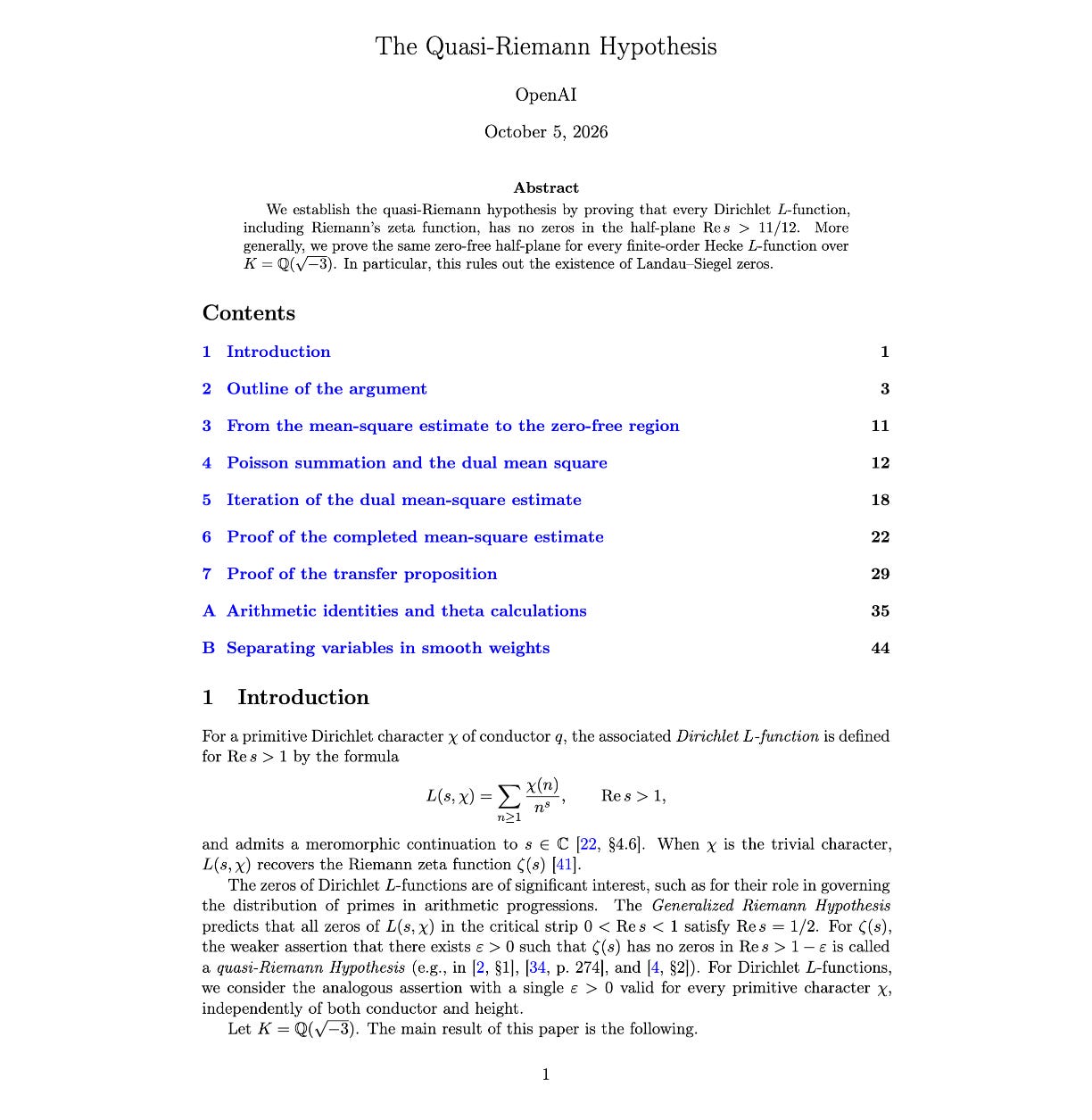
PaperSharing AI progress in mathematics
OpenAI publishes new results on open problems in mathematics from an internal frontier model and shares Lean proof formalizations and research details on GitHub.
Memento 3: Model-Based Recursive Self-Improvement through Reflective Rulebooks
We introduce Memento 3, building on the Memento series to enable frozen LLM agents to continually learn explicit world models through external memory.
 Paper
PaperBeyond Imitation: A Framework and Benchmark for LLM-Assisted Peer Review
Here, we introduce a verification-centric perspective on LLM-assisted peer review, emphasizing error detection as a critical and resource-intensive task.
 Paper
PaperRISED: Rubrics for Agentic Multi-Environment Selection and Self-Distillation
RISED: Rubrics for Agentic Multi-Environment Selection and Self-Distillation
SparseDecoding: Decoding-Aware Pruning for Accurate and Efficient LLM Inference
The memory-bound nature of the decoding stage of large language model (LLM) inference incurs significant latency.
REMORY: Learning Residual Memory for Context Compaction
We introduce REMORY, a neural memory network that supplements the summary with a bounded sequence of soft memory tokens.
VibeEdit: Image Editing with Canvas Instructions
We introduce a new image editing interface that lets users place spatial marks and optional short notes directly on the image.
SpatialOPSD: Self-Distilling Spatial Intelligence from Verified Coding Agent Traces
Spatial coding agents significantly improve spatial reasoning in Multimodal Large Language Models (MLLMs) by using external tools to generate verified execution traces.
MIMESIS: Learning User Simulators as Training Environments for Interactive Agents
We introduce MIMESIS, a purpose-built user simulator trained on human conversations with explicit reasoning supervision and 13 realistic behavioral patterns derived from real user interactions.
V-CoLA: Vision Token Compression with Linear Attention
To this end, we propose V-CoLA, an efficient training-free token compression framework specifically designed for linear attention.
Real Long-Term Memory for AI: A 50-Million-Token Window That Is Faster and Cheaper Than Recompute
We test a memory layer, the public package galahad-kv, that saves the KV state of each block of about 16,000 tokens to encrypted local NVMe disk and loads it back later, byte-exact, without recomputing it.
Scaling to Tens of Thousands of Test-Time Iterations with Loop-Native Attention Residuals
In this paper, we introduce InfiLoop, a loop-native residual connection that learns which past computations to retain and how much to accept from each new update.
On-Policy Distillation Teaches New Skills but Not New Knowledge
On-policy distillation (OPD) strengthens language-model reasoning, yet whether students acquire new factual knowledge or compositional skill for multi-step reasoning remains unknown.
From Traces to Agentic Worlds: Agentic Language World Models for Interactive Environment Simulation
We explore agentic language world modeling: rather than rebuilding an executable environment, a world model agent serves as the environment for a task agent and supports faithful and stateful simulation.
The Lattice of Transition Laws
Diffusion and autoregression (AR) have long been seen as different categories of generative models, with diffusion specialising in continuous fields and AR specialising in discrete tokens.
U-Space: Uncovering When and Why Uncertainty Arises in Language Models
Large language models are informing decisions with ever-higher stakes.
UniSkill: Learning Actor-Aligned Skill Proposals for an Evolving Policy
In this paper, we introduce UniSkill, which uses a shared policy to interact with the environment and propose skillbank edits (Add, Update, or No Edit) from the resulting trajectories.
From Prompting to Composing: A Spatial Canvas Interface for Poster Generation
We introduce a Spatial Canvas Interface that enables users to directly compose generation intent in space through four complementary binding types: semantic, identity, text, and pixel, together with Text Specifications for individual elements and global appearance.
Opera: A Verbal Critic Framework for Long-horizon Coding Agents
We present Opera, a verbal critic framework that treats each correction as a persistent note, followed until the diagnosed problem is resolved.
 Paper
PaperAMLworld-Compact: Importance-Weighted Downsampling for Cost-Effective LLM Evaluation and Error Diagnosis
We introduce AMLworld-Compact, an evaluation set that retains every illicit test transaction and samples benign transactions from supervised-score strata.
Frozen Models, Evolving Expertise: Model-Agnostic Learning from Deployment Experience for Multimodal Medical AI
Large language models (LLMs) and vision-language models (VLMs) are usually frozen after deployment, so they do not learn from the cases they solve.
Can LLMs Fix It Without Code? Toward Automated Verification of No-Code Bug Fixes
This study proposes an automated, execution-based pipeline for evaluating the capability of large language models (LLMs) to generate no-code fixes in a real browser environment.
Meta-Reflective Evolution Effectively Improves Production AI Systems
We introduce CoCoEvolve (Cortex Code Evolve), an evolutionary optimizer built around what we call meta-reflection, wherein an agentic mutator (Cortex Code) selectively retrieves evidence from the entire evolutionary history and probes the live system before verifying and proposing mutations.
Incremental Open-Ended Deep Research with Structured Harness
We introduce Incremental Open-Ended Deep Research (Incremental-OEDR), a research setting that treats a report as an evolving research state and incrementally updates it by preserving valid knowledge, revising outdated or incomplete content, and incorporating newly available information.
Writing for the Reviewer: Defensive Writing in GPT Models
Defensive writing grows with GPT version.
MetaOPD: Meta-Learned Token Weighting for On-Policy Distillation
In this paper, we propose MetaOPD, a bilevel optimization framework that jointly learns the student model and a lightweight token-weighting network.
A self-learning scientific agent for X-ray diffraction
Here we introduce Gan Jiang, a self-learning agent for powder X-ray diffraction built on a diffraction-analysis ecosystem we developed: XMatcher, XQueryer, XDecomposer and WPEM.
Which Skill to Distill? SGUID: Selecting a Compact Skill Bank for Model-Skill Co-Evolution
Skills, reusable procedural guidance added at inference, can substantially improve LLM downstream performance (Li et al., 2026).
SanSi: A Looped Typed Decision Model for System 1.5 Thinking
We propose SanSi, which turns a pre-trained looped language model into a typed decision model.
Diffusion Meta-Prompting and Steering for Generalizable Foundation Model Adaptation
In this paper, we introduce a Diffusion Meta-Prompt (DMP) model , a framework that models the distribution of learned prompts using diffusion models.
MotherTree: Meta-learning on synthetic data improves decision tree training
We introduce MotherTree, a tabular transformer that meta-learns decision tree induction: given a training set for a new task, it outputs a hard, axis-aligned decision tree, equivalent in form to classically trained trees, in a single forward pass.
Foundations of Large Language Models
This is a book about large language models.
REFLECT: Role-Aware Detection of Sentiment, Emotion, Politeness, and Formality
Detecting communicative meaning in dialogue requires modeling not only lexical content but also the participant-role structures through which sentiment, emotion, politeness, and formality (SEPF) are expressed.
Transformer-based In-Context Score Operator Learning for Diffusion Models
We introduce an in-context solution operator learning framework for diffusion models, in which each target distribution is treated as a task drawn from a meta-distribution and is specified at inference time by an empirical context set.
How Narrative Wrapping Affects LLM Refusal: A Cross-Language Benchmark and Defense
Safety-aligned language models often refuse a harmful request stated directly but answer the same request inside a role-play or narrative wrapper.
SpecFold: Folding Multi-Branch Redundancy for Faster Speculative Decoding in Diffusion Language Models
Diffusion large language models (DLLMs) generate text through iterative block denoising, and multi-branch speculative decoding accelerates this process by verifying a main branch together with multiple draft branches in a single forward pass.
Exploring Attention Sinks in Text-to-Image Transformers from Diffusion and Autoregressive Models
To fill this gap and better understand how text-to-image Transformers allocate and route attention, we explore this phenomenon of text-to-image transformers across bidirectional diffusion models and causal autoregressive models.
Data-Adaptive Mahalanobis Metric Learning for Cross-Head Attention in Transformers
In this paper, we propose Data-Adaptive Mahalanobis Cross-Head Attention (DAMCHA), a simple and effective attention mechanism that generalizes Multi-Head Attention (MHA) through the lens of metric learning.
Vision Transformers Learn Word Meaning from Images Alone
We show that the two largest DINOv3 vision transformers organize words rendered in images by word meaning, despite being pretrained using self-supervision on images only, without paired captions, class labels, or other language supervision.
SemanticFold: Latent Sequence Compression SeparatesLanguage Modeling, Decodability, and Reasoning
We introduce SemanticFold, a compression scheme that folds prefix hidden states at learned boundaries, and evaluate it across five model scales: Qwen3-1.7B, Qwen3-8B, SmolLM2-1.7B, Pythia-1.4B, and Pythia-6.9B.
Cache the Encoder Within:Compact, Reusable Memory across LLM Queries
Repeated queries over shared documents incur redundant encoding, while caching model states introduces persistent storage costs.
Overcoming Data Imbalances with Expert Selection Biases
Mixture-of-Experts (MoE) models have become the standard architecture for frontier LLMs. The multiple parallel experts in each transformer block theoretically enable expert specialization according to categories such as domains, languages, or modalities during pretraining.
Incidental information contaminates patient notes and disrupts clinical reasoning in large language models
We propose a dual encoding hypothesis of clinical reasoning and distraction in LLMs, with preliminary evidence that LLM components associated with disruption by incidental information also support clinical reasoning.
Monarch-MoE: Structured Experts for Multimodal Continual Instruction Tuning
Learning new tasks in multimodal continual instruction tuning can cause catastrophic forgetting of previously acquired knowledge.
Marformer: A Transformer for Predicting Missing Data Distributions
We present the Marformer, a Transformer trained to directly predict conditional marginals given any set of observed values.
Principled Under Pressure: Post-Training Decides Whether LLMs Act on Their Own Moral Judgment
Language models increasingly act as agents.
Your Discrete Graph Diffusion Model is Secretly Memorizing
Discrete graph diffusion models (GDMs) corrupt the graph structure by adding noise independently to nodes and edges under a Markovian noise model.
Forms of LLM-Integrated Applications from LLM-Chats to Autonomous AI Agent System
Large language models (LLMs) are increasingly embedded as components in software systems, marketed under labels such as chatbot, copilot, retrieval-augmented generation, workflow, coding agent and AI agent.