Explore
Everything AION read, in seven sections. Pick one, a topic or a time window.

Odyssey-3 is a new generative world model that you can try for free
Odyssey is making its world model Odyssey-3 available as a public research preview.
Multi-Agent Egocentric World Model with Fine-Grained Embodied Interaction
We propose Multi-agent Egocentric World Model (ME-World), which jointly denoises multiple ego streams in a shared token sequence, conditions each stream on all agents' target-view poses, and grounds generation with shared environment memory.
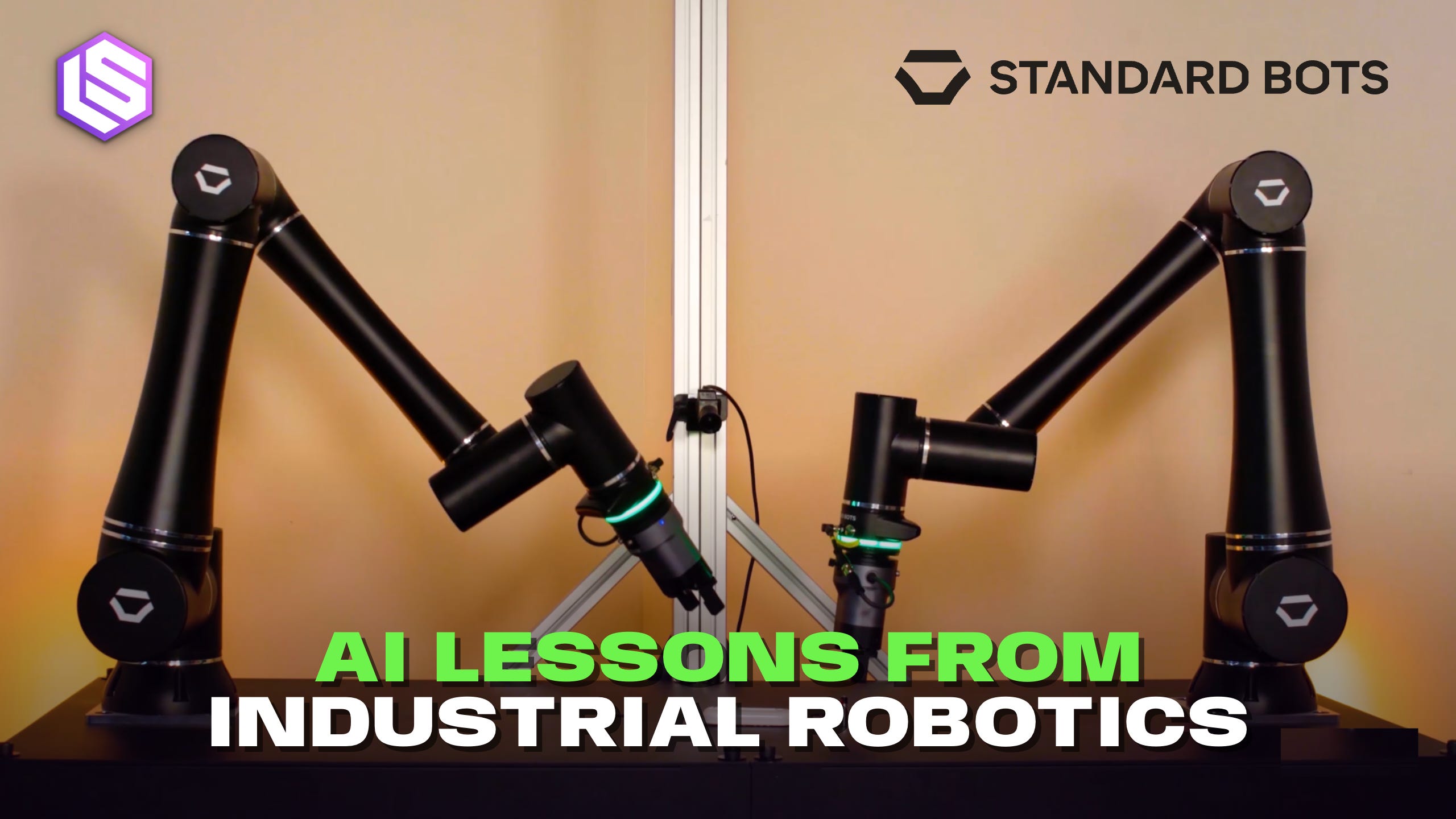
Building AI for Reliable Execution: Lessons From Industrial Robotics
Standard Bots claims to be “America’s largest AI-native industrial robot manufacturer.” It recently raised $200 million at a $1 billion valuation, in a series C round led by General Catalyst and RoboStrategy, a fund focused on robotics.
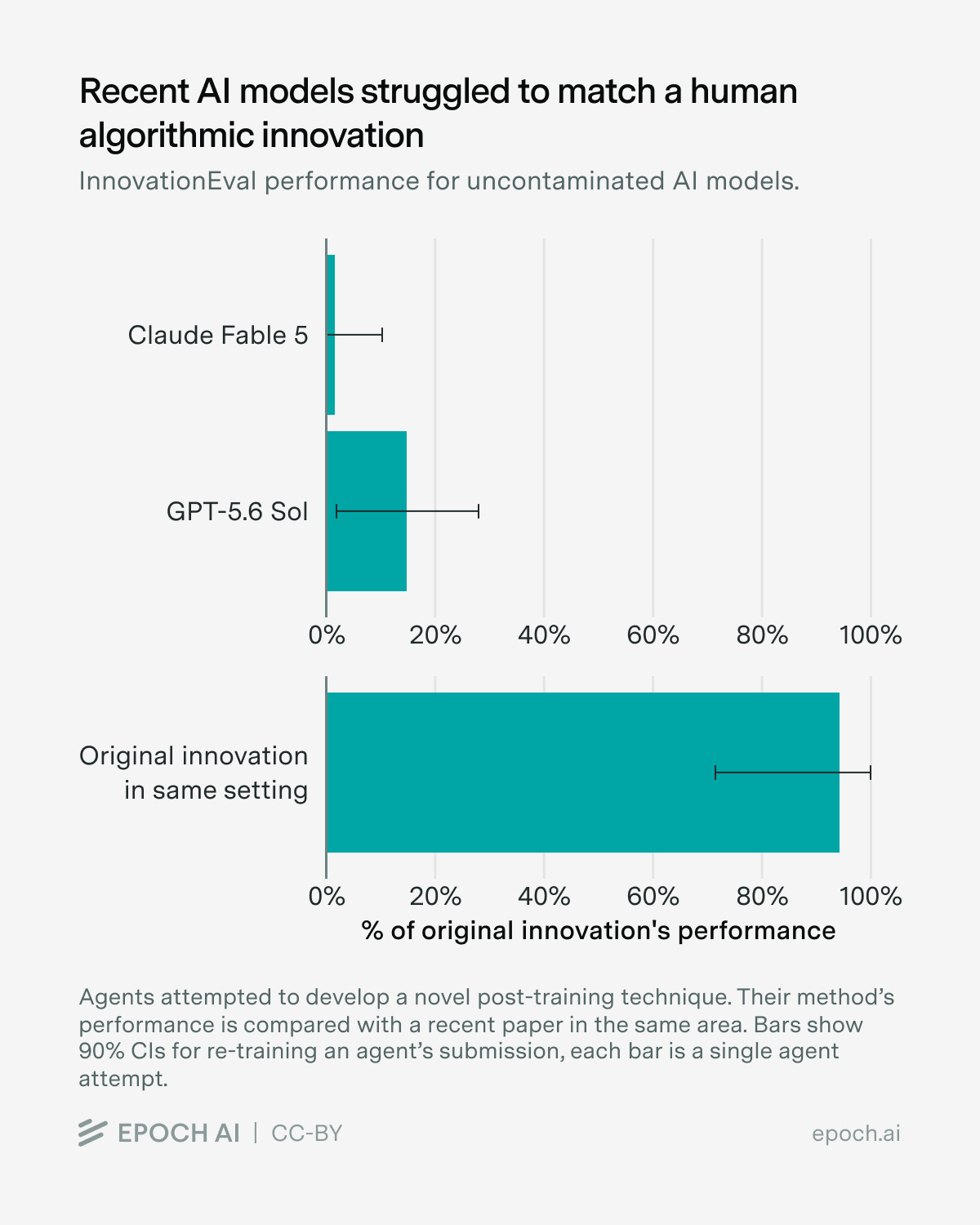
Can AI automate AI R&D yet?
Existing evidence shows that AI can perform software engineering tasks relevant to AI research, dataset creation, open-ended optimization of defined metrics (autoresearch), and more.
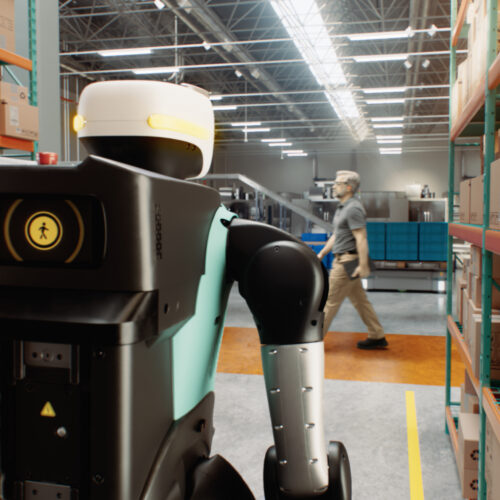
Nvidia's big bet on physical AI aims for safer robotaxis, humanoid robots
“Now the AI models are getting capable, the robot hardware is getting capable, and a thing we thought is going to be the next bottleneck is safety,” Amit Goel, head of robotics ecosystem and edge computing at Nvidia, told Ars. “So that's why we launched our Halos for Robotics to unlock the capability of these systems.”
Claude Dashboards & Motion
Ask Claude for live dashboards and animated explainers

She Designed Meta’s New AI Logo. Then Came the Hate
Jessica Hische knew working for Meta might upset some people.
FearCaut-Qwen: Affective Steering in a Vision-Language Model Shifts the Decision Criterion for Hazard Assessment
Vision-language models (VLMs) show great potential for damage assessment after a disaster, but a recurring deficiency is that they are reluctant to declare a hazard; that is, recall is low even when overall accuracy appears adequate.
5 Steps to Create SimReady Assets for Robotics with Frontier AI Models
Preparing CAD assets for robotics simulation requires more than converting geometry to OpenUSD: developers must configure and validate materials, collision...Preparing CAD assets for robotics simulation requires more than converting geometry to OpenUSD: developers must configure and validate materials, collision geometry, joints, and other physics properties before testing robot behavior.

Introducing Dan Kagan-Kans
We just published the first post by our newest writer, Dan Kagan-Kans.

Attempts to Keep Humans in the AI Loop May Actually Push Them Out
A crucial safeguard against AI agents going rogue—keeping humans in the loop to review and approve their decisions—will fail unless designers and users change their current practices, a trio of leading AI ethics researchers argue.
Bringing predictive analytics to the agentic AI era
In 2026, the question for enterprise AI is no longer whether predictive models can outperform statistical forecasts—that argument is settled.

AI agents overstate their results and remain far from autonomous research, study finds
Epoch AI and Anthropic independently found the same thing: current AI models like GPT-5.6 Sol and Claude Fable 5 can run experiments but lack scientific self-criticism and genuine creative thinking.
DreamTrue: Action-Faithful Robot World Model with Counterfactual Post-Training
We present DreamTrue, a multi-view, cross-embodiment robot world model for action-faithful and physically plausible video prediction.
Embodied Turing Machines: Stateful Code for Robot Recursive Self-Improvement
We propose a different view: the embodied world is an Embodied Turing Machine, whose tape is the robot and environment state and rules are the policy.
SuperNav: An Agentic Navigation System for Any Task in Any Scene
General-purpose service robots need navigation systems that can handle diverse human requests in unfamiliar environments, combining task generality with scene generality.
AgentGarten: Code Worlds for Evolving Agents
We introduce AgentGarten, a framework that couples simulators and game engines with a shared neural renderer to build real-time interactive environments.
ViSkill: Reinforcing VLM Agents with Evolving Visual-Native Skills
We propose ViSkill, a visual-native skill learning framework that encodes successful interactions as composite visual skill cards directly accessible to VLM agents.
SpatialOPSD: Self-Distilling Spatial Intelligence from Verified Coding Agent Traces
Spatial coding agents significantly improve spatial reasoning in Multimodal Large Language Models (MLLMs) by using external tools to generate verified execution traces.
Beyond Spatio-Temporal Priors: A Generalizable Approach for Dense Correspondence Matching
To establish identity-preserving correspondence across such transformations, we introduce FreeMatching, a generalizable framework combining generative and semantic foundation representations with heterogeneous supervision from classical datasets, tracked videos, and synthetic scenes.
Q-Learning with Scalar Adjoint Matching
Adjoint matching offers a principled way to update the flow model itself by propagating value information from the final action back to each flow step, but it requires a vector--Jacobian product through the policy at every step, a cost that grows with the number of flow steps and the policy size.
From Prompting to Composing: A Spatial Canvas Interface for Poster Generation
We introduce a Spatial Canvas Interface that enables users to directly compose generation intent in space through four complementary binding types: semantic, identity, text, and pixel, together with Text Specifications for individual elements and global appearance.
BrickBench: Evaluating Agentic Brick Design
We propose BrickBench, a benchmark for agentic text-conditioned LEGO-set design.
RoboJEPA: Scaling Laws for Multi-Embodiment Robotic Latent World Models
Researchers introduced RoboJEPA, an 8B-parameter multi-embodiment latent world model that establishes compute scaling laws and enables zero-shot real-robot planning toward goal images.
USDCraft: Geometrically Grounded Programmatic Modeling of Articulated 3D Assets for Simulation
To address these limitations, we formulate articulated asset reconstruction as programmatic modeling grounded in partial geometric evidence and introduce USDCraft, a framework in which a pretrained LLM writes and revises executable programs for simulation-ready articulated assets without task-specific training.
MIMESIS: Learning User Simulators as Training Environments for Interactive Agents
We introduce MIMESIS, a purpose-built user simulator trained on human conversations with explicit reasoning supervision and 13 realistic behavioral patterns derived from real user interactions.
Predicting Cable Dynamics with Physical Attention Bias
Learned simulators for deformable linear objects (DLOs) such as cables have to predict the motion of cables they were not trained on and stay stable over long rollouts.
CADFather Reconstructs Parametric CAD Programs Using Coordinated Tools
CADFather is an autonomous agentic system that coordinates complementary tools and a vision-language assistant to reconstruct parametric CAD models from 3D meshes without additional training.
UniSkill: Learning Actor-Aligned Skill Proposals for an Evolving Policy
In this paper, we introduce UniSkill, which uses a shared policy to interact with the environment and propose skillbank edits (Add, Update, or No Edit) from the resulting trajectories.
Synthesis Superintelligence: from Semiconductors to Superconductors — Periodic Labs’ Liam Fedus and Ekin Dogus Cubuk
We go deep on Periodic’s vision for “synthesis superintelligence”: reinforcement learning grounded in physical experiments, AI-powered materials characterization, simulations and density functional theory, high-throughput labs, and systems that learn from the entire process of doing science rather than only its published results.
LeWAM: A JEPA World Action Model with Diffusion-Steering-Based MPC
We introduce LeWAM, a bidirectional transformer for forward, backward, inverse dynamics and policy prediction, on a decoder-free JEPA latent trained end-to-end through all four modes.
LiteNWM: Efficient Latent World Models for Onboard Visual Navigation in the Wild
We present LiteNWM, a latent navigation world model that shares visual encoding across candidates and jointly predicts their action-conditioned future representations at multiple horizons, while a learned scorer uses these predictions to select trajectories.
Rewiring Semantics, Dynamics, and Control: A Simple yet Effective Action-Centric Tri-Stream Transformer
Vision-Language-Action (VLA) models have emerged as a prominent framework for complex robotic manipulation, building on the strong semantic understanding of pretrained Vision-Language Models (VLMs).
SPW-Nav Streams Language-Guided Panoramic Video in Real Time
Researchers introduced SPW-Nav, a panoramic world model that interprets language movement instructions to stream one minute of real-time 2K 360-degree video from a single panorama.
Deflating the Hessian: Rank-4 W4A4 Quantization for Multimodal Diffusion Transformers
In diffusion transformers, low-rank branches can mitigate 4-bit weight--activation (W4A4) post-training quantization (PTQ) loss by decomposing each weight into a low-bit residual and a high-precision low-rank component.
CARE: Certifying Acceleration for Vision-Language-Action Inference
Prior work accelerates VLA inference using techniques like action chunking and visual-token pruning, typically evaluating based on latency and average task success.
On the estimation and validity of AI time horizons---a statistical look at the METR plot
On 228 tasks and 26 AIs, we recompute the time horizons using splines and item-response theory to relax the assumption that the AI difficulty of a task depends linearly on the log of human time.
VersaCamVLA: Camera-Configurable VLA Policies for Robotic Manipulation
To overcome these limitations, we propose VersaCamVLA, a camera-configurable framework that decouples camera-set representation from action learning.
System Switch: When Should a Fast Decision Model Stop and Think?
Dual-process agents pair a fast policy with a slow deliberative model.
CausalDreamer: Learning Predictive World Models with Latent Disentanglement
We propose CausalDreamer, which keeps the tokenizer frozen and re-encodes its latent into a factored representation of four groups along two axes: controllability, where only the two controllable groups receive the action, and reward relevance, learned by predicting the reward from the two reward-relevant groups.
PLaW-VLA: Predictive Latent World Modeling for Vision-Language-Action Policies
Learning to predict how the world evolves can provide vision-language-action (VLA) policies with predictive context for long-horizon control, but its effectiveness depends on what future representation is modeled and how it conditions action generation.
Recompose and Refine Latent Reasoning Flows for Vision-Language-Action Models
Latent reasoning enables vision-language-action (VLA) models to transform multimodal observations into task-relevant internal states before generating continuous robot actions.
Tracing the Thoughts of a Coding Agent Playing ARC-AGI-3: Lessons for Continual Learning
We study how a coding agent learns across a sequence of abstract reasoning tasks.
Humanoid World Action Model With Joint State--Action Generation
We propose HWAM, a Humanoid World Action Model with joint state--action generation, which makes the robot's post-execution proprioceptive state an explicit prediction target.
REACT: Rolling Denoising and Dual Decoupling for Reactive Robot Control with VLA Models
Flow-based vision-language-action (VLA) models generate action chunks for temporally coherent robot motion, but chunked control creates a fundamental closed-loop trade-off: long chunks provide smooth execution, whereas frequent replanning improves reactivity at the cost of action discontinuities.
WAM-Cache: Staleness-Bounded KV Reuse for Efficient World Action Models
World Action Models (WAMs) enable generalist robot manipulation by conditioning an action expert on representations from a pretrained video Diffusion Transformer (DiT).
CAPABLE: Capability-Aware Policy Adaptation via Behavioral Latent Encoding
We introduce CAPABLE, a unified capability-aware adaptation framework for frozen VLAs that integrates self-supervised capability inference with residual reinforcement learning.
Beyond Visual Enhancement: Adaptive Multi-Context Steering to Mitigate LVLM Hallucinations
Hallucination remains a significant challenge in Large Vision-Language Models (LVLMs).